OHIO’S POWER AND CONTROL WHEEL WITH STATUTES
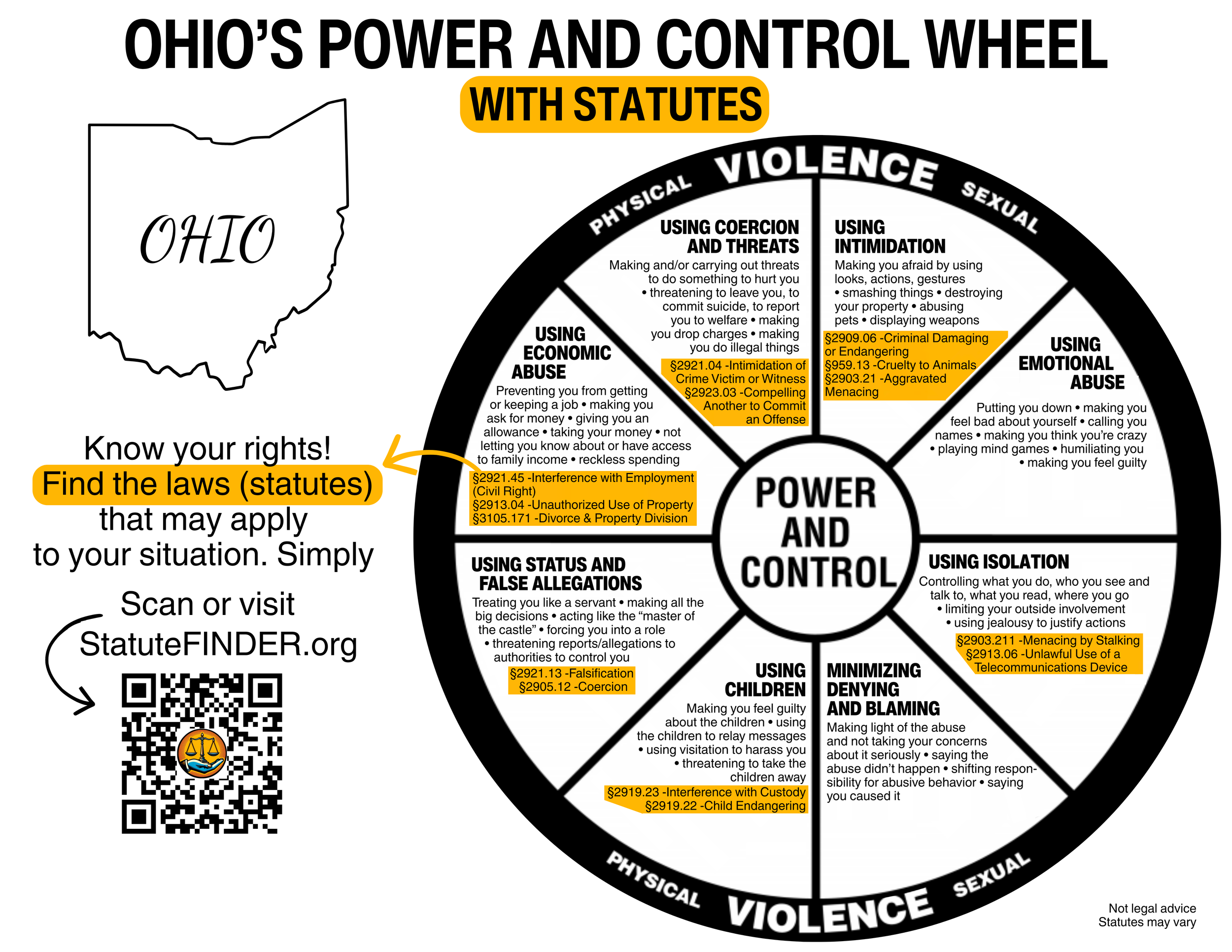
Click HERE to Download pdf
of the Ohio Wheel with statutes
Not legal advice. Statutes vary. Below is a list of potential statutes.
The simplest way to know your rights and find the laws (statutes) that may apply to your situation is by visiting StatuteFINDER.org and inputting your situation into our AI. It’s free & easy.
1) USING INTIMIDATION: Making you afraid by using looks, actions, gestures • smashing things • destroying your property • abusing pets • displaying weapons
1. Domestic Violence – Ohio Revised Code § 2919.25 🔗
This law covers not only physical harm but also threats of force and actions that cause fear of imminent harm. Throwing plates, punching walls, and displaying a gun to intimidate you—even without direct threats—can be considered acts of domestic violence if they were meant to make you afraid.
Evidence: Texts admitting intent to scare, photos of damage, veterinary records, your statement, and any witness accounts.
Reporting window: 2 years from the date of the incident (statute of limitations for misdemeanors; longer for felonies).
2. Aggravated Menacing – Ohio Revised Code § 2903.21 🔗
This statute applies when someone causes you to believe they will cause serious physical harm, including by displaying a weapon or making threats. Showing you a gun and hinting at its use, even without explicit words, can qualify if it made you fear for your safety.
Evidence: Your statement, any texts referencing the gun, photos of the gun if available, and witness statements.
Reporting window: 2 years from the incident.
3. Criminal Damaging or Endangering – Ohio Revised Code § 2909.06 🔗
Destroying your lamp, burning your clothes, and breaking plates are all forms of property destruction. This law makes it a crime to knowingly cause substantial harm to another’s property.
Evidence: Photos of damaged property, receipts, your statement, and any texts admitting to the acts.
Reporting window: 2 years from the incident.
4. Cruelty to Animals – Ohio Revised Code § 959.13 🔗
Kicking your dog and causing injury is a criminal offense in Ohio. The fact that your dog needed veterinary care strengthens this case.
Evidence: Veterinary note, photos of injuries, your statement, and any witness accounts.
Reporting window: 2 years from the incident.
2) USING EMOTIONAL ABUSE: Putting you down • making you feel bad about yourself • calling you names • making you think you’re crazy • playing mind games • humiliating you • making you feel guilty
In Ohio, emotional abuse by itself—such as name-calling, humiliation, or making you feel guilty—does not have a specific criminal statute unless it is accompanied by threats, harassment, or other forms of abuse. However, some related statutes may apply if the behavior includes:
Threats of harm (even if not carried out)
Repeated unwanted contact (harassment or stalking)
Intimidation or coercion
If any of the emotional abuse you described involved threats, repeated contact, or made you fear for your safety, please let me know. That would allow me to identify the closest applicable Ohio statutes for your situation.
3) USING ISOLATION: Controlling what you do, who you see and talk to, what you read, where you go • limiting your outside involvement • using jealousy to justify actions
1. Menacing by Stalking (Ohio Rev. Code § 2903.211) 🔗
This law makes it illegal for someone to engage in a pattern of conduct that knowingly causes another person to believe they will be physically harmed or experience mental distress. Placing a GPS tracker on your car without your consent, monitoring your movements, and making you feel unsafe can fall under this statute.
Evidence: GPS tracker device, photos of the device, text messages or emails showing threats or monitoring, witness statements, any records of his anger or violence related to your movements.
Reporting window: 2 years from the date of the last incident (this is called the "statute of limitations").
2. Unlawful Use of a Telecommunications Device (Ohio Rev. Code § 2913.06) 🔗
This law prohibits using any telecommunications device (which can include GPS trackers) to commit a criminal offense or invade someone’s privacy.
Evidence: The GPS tracker itself, receipts or records of purchase, expert confirmation that the device was used to track you, any communications where he admits to tracking.
Reporting window: 2 years from the date of the offense.
4) MINIMIZING DENYING AND BLAMING: Making light of the abuse and not taking your concerns about it seriously • saying the abuse didn’t happen • shifting responsibility for abusive behavior • saying you caused it
In Ohio, the behaviors you described—minimizing, denying, and blaming—are often part of a pattern of emotional or psychological abuse. While these actions alone may not always be prosecuted as standalone crimes, they are highly relevant in domestic violence cases and can strengthen your case if combined with other forms of abuse (such as physical harm, threats, or harassment).
Ohio law recognizes domestic violence as more than just physical harm. Emotional and psychological abuse can be considered when seeking a protection order or in family court matters.
5) USING CHILDREN: Making you feel guilty about the children • using the children to relay messages • using visitation to harass you • threatening to take the children away
1. Interference with Custody – Ohio Revised Code § 2919.23 🔗
If he is not following the custody order, shows up late, or threatens to take the children out of state without permission, this can be considered interference with custody. This law makes it illegal to keep, take, or entice a child from the parent or guardian who has legal custody.
Evidence needed: Custody orders, text messages/emails about exchanges, records of missed/late exchanges, witnesses, any threats to take the children away.
Reporting window: 2 years from the incident (this is called the "statute of limitations").
2. Child Endangering – Ohio Revised Code § 2919.22 🔗
Exposing children to inappropriate adult information, causing emotional or psychological harm, or creating an environment that negatively affects their well-being and school performance can be considered child endangerment.
Evidence needed: Statements from children, school records showing changes in behavior/performance, reports from counselors or teachers, documentation of what was said to the children.
Reporting window: 2 years from the incident.
6) USING STATUS AND FALSE ALLEGATIONS: Treating you like a servant • making all the big decisions • acting like the “master of the castle” • forcing you into a role • threatening reports/allegations to authorities to control you
1.Falsification – Ohio Revised Code § 2921.13 🔗
If he fabricates evidence or makes false statements to authorities (such as police or immigration), this is a crime in Ohio. Falsification includes knowingly making a false statement or creating false evidence with the purpose to mislead public officials.
Evidence: Proof of fabricated evidence, recordings of threats to make false reports, any documentation showing the truth.
Reporting window: 2 years for misdemeanor, 6 years for felony.
2.Coercion – Ohio Revised Code § 2905.12 🔗
Threatening to report you to immigration or authorities to control your actions is considered coercion. Coercion is using threats to make someone act against their will.
Evidence: Recordings, texts, emails, or witness statements about threats to report you.
Reporting window: 2 years for misdemeanor, 6 years for felony.
7) USING ECONOMIC ABUSE: Preventing you from getting or keeping a job • making you ask for money • giving you an allowance • taking your money • not letting you know about or have access to family income • reckless spending
1. Interference with Employment – Ohio Revised Code § 2921.45 (Interfering with Civil Rights) 🔗
Preventing you from working, contacting your employer to sabotage your job, or otherwise interfering with your right to employment can be a violation of your civil rights under Ohio law.
Evidence: Communications with your employer, termination letters, texts/emails showing interference, statements from your manager.
Reporting window: 2 years (statute of limitations).
2. Unauthorized Use of Property – Ohio Revised Code § 2913.04 🔗
Accessing your bank account without permission and taking your money may be considered unauthorized use of property or computer, which is a crime in Ohio.
Evidence: Bank records, account access logs, communications admitting to the access, and any documentation showing you did not give permission.
Reporting window: 2 years for misdemeanors, 6 years for felonies.
3. Identity Fraud – Ohio Revised Code § 2913.49 🔗
If your spouse used your personal information to access your accounts or take money, this could also be identity fraud.
Evidence: Proof of unauthorized access, bank statements, and any communications or admissions.
Reporting window: 6 years from the offense.
4. Coercion – Ohio Revised Code § 2905.12 🔗
Forcing you to quit your job or preventing you from working through threats or intimidation may be considered coercion.
Evidence: Texts, emails, witness statements, employer records, and any documentation of threats or interference.
Reporting window: 2 years for misdemeanors, 6 years for felonies.
5. Divorce and Property Division – Ohio Revised Code § 3105.171 🔗
Ohio is an “equitable distribution” state, not a community property state. This means marital debts and assets are divided fairly, not always equally, during divorce. Debts your spouse incurred to punish you or recklessly after marriage may be argued as “dissipated” assets, and you may not be responsible for half.
Evidence: Credit card statements, proof of intent to punish, communications, and timing of the debt.
8) USING COERCION AND THREATS: Making and/or carrying out threats to do something to hurt you • threatening to leave you, to commit suicide, to report you to welfare • making you drop charges • making you do illegal things
1. Intimidation of Crime Victim or Witness – Ohio Revised Code § 2921.04 🔗
Threatening you to make you drop charges or terminate a protection order is a crime.
Evidence: Court records, texts, emails, witness statements, recordings.
Reporting window: 2 years from the date of the offense.
2. Compelling Another to Commit an Offense – Ohio Revised Code § 2923.03 (Complicity) 🔗
If someone forces or encourages you to commit a crime (like stealing or selling drugs), they can be charged as if they committed the crime themselves.
Evidence: Messages, recordings, witness statements, any proof of their instructions or threats.
Reporting window: 2 years for misdemeanors, 6 years for most felonies.