How a National Domestic Violence Hotline Referral Reached StatuteFINDER
A survivor recently contacted StatuteFINDER with a message that immediately got our attention:
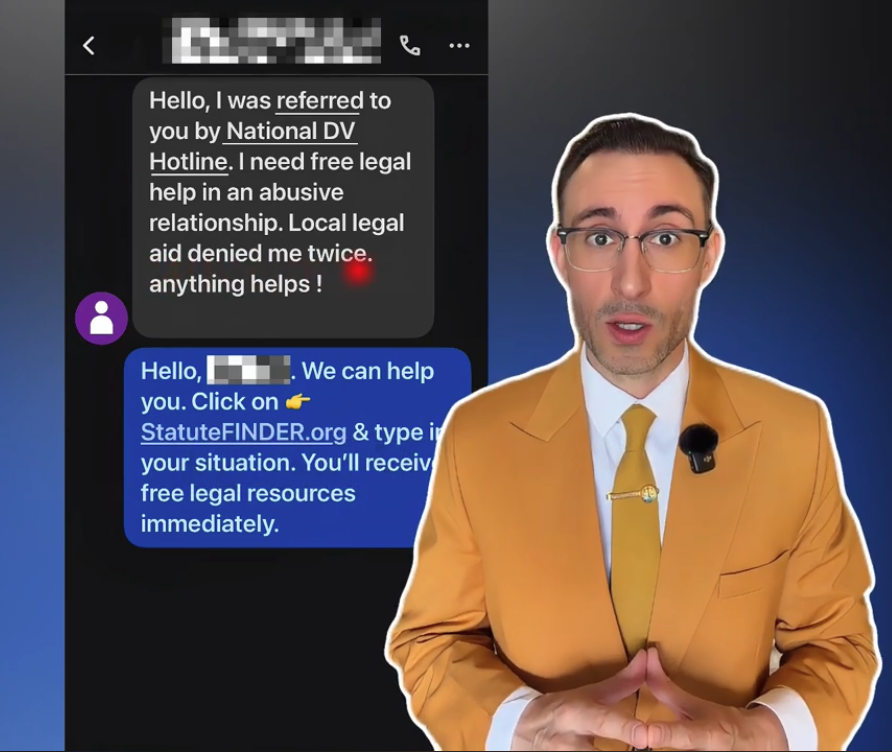
“Hello, I was referred to you by National DV Hotline. I need free legal help in an abusive relationship. Local legal aid denied me twice. Anything helps!”
What mattered most to us wasn’t simply where the referral came from.
It was what happened after the survivor reached us.
We responded and connected her with StatuteFINDER.org, our free legal-information resource for domestic violence survivors and advocates.

Later, when we checked in to ask whether StatuteFINDER had been helpful, she responded:
“OMG yes! After 2 years I couldn’t get any help… thanks to you I was able to finally get help. I’m sooo grateful for you & this free legal tool.”

She later gave us permission to share the conversation publicly and added:
“Five-star service. More people need to know.”
So we’re sharing it.

An important clarification about the National Domestic Violence Hotline
We want to be precise about the relationship.
StatuteFINDER is not partnered with or endorsed by the National Domestic Violence Hotline.
StatuteFINDER is an independent nonprofit organization. We contacted The Hotline’s directory team, submitted information about our nonprofit and the services we provide, and after their review, StatuteFINDER was added to its directory of service providers.
The Hotline publicly describes this process as its directory of service providers, and separately explains that its advocates connect survivors with community resources and referrals.
We are grateful to be included as a resource survivors may be connected to.
The real goal: helping survivors better understand their rights
The survivor in this story was looking for legal help.
That is where StatuteFINDER is different from many general domestic violence resources.
StatuteFINDER.org provides free, 24/7, multilingual legal information that helps survivors better understand their rights by identifying potentially relevant statutes (laws) that may apply to what they experienced.
That order is intentional.
The goal is not to overwhelm a survivor with statute numbers or legal terminology.
The goal is to help someone better understand their rights.
The statutes come next.
A survivor may know that something frightening, controlling, threatening, or abusive happened to them without knowing how the law may describe that conduct.
StatuteFINDER helps bridge that gap.
A survivor can describe what happened in ordinary language. StatuteFINDER can then help identify potentially relevant statutes and legal information that may apply to those circumstances.
That information can give the survivor a clearer starting point for conversations with advocates, legal professionals, law enforcement, courts, or other appropriate resources.
StatuteFINDER provides legal information, not legal advice.
Yes, we use AI. But AI isn’t the point.
StatuteFINDER uses artificial intelligence to help make legal information available quickly.
But we don’t believe the most important part of this story is AI.
The important part is what the technology allows us to do for someone who needs information.
Domestic violence does not operate on a 9-to-5 schedule. A survivor may be searching for answers late at night, during a weekend, or at a moment when another resource is unavailable.
Technology makes it possible for StatuteFINDER to remain available 24 hours a day, seven days a week, and to provide information in multiple languages.
AI also does not replace the role of human advocates.
Domestic violence advocates provide something technology cannot replace: human judgment, context, empathy, safety planning, and personal support.
Our goal is to give survivors and advocates another tool.
More than 9,000 people have already used StatuteFINDER for free
This survivor’s experience is meaningful to us, but it is not the only evidence we look at.
StatuteFINDER has now helped more than 9,000 people for free.
We have received survivor reviews, video testimonials from survivors and advocates, and developed relationships with domestic violence organizations around the country.
Each form of feedback helps us answer an important question:
Is this resource actually useful to the people it was created to serve?
The survivor in this referral gave us one of the clearest answers we could receive:
“More people need to know.”
We agree.
Why this matters for domestic violence agencies
Executive directors, program directors, advocates, shelters, hotlines, legal advocacy programs, and survivor-support organizations all maintain networks of resources.
No single domestic violence organization can provide every service a survivor may need.
That makes referrals important.
When a survivor needs legal information or wants to better understand the rights that may apply to their situation, StatuteFINDER can be another resource in that network.
There is no cost to the survivor.
There is no cost to the referring domestic violence agency.
And an agency does not need a formal partnership or MOU with StatuteFINDER simply to place the resource on its referral list.
Add StatuteFINDER to your domestic violence resource list
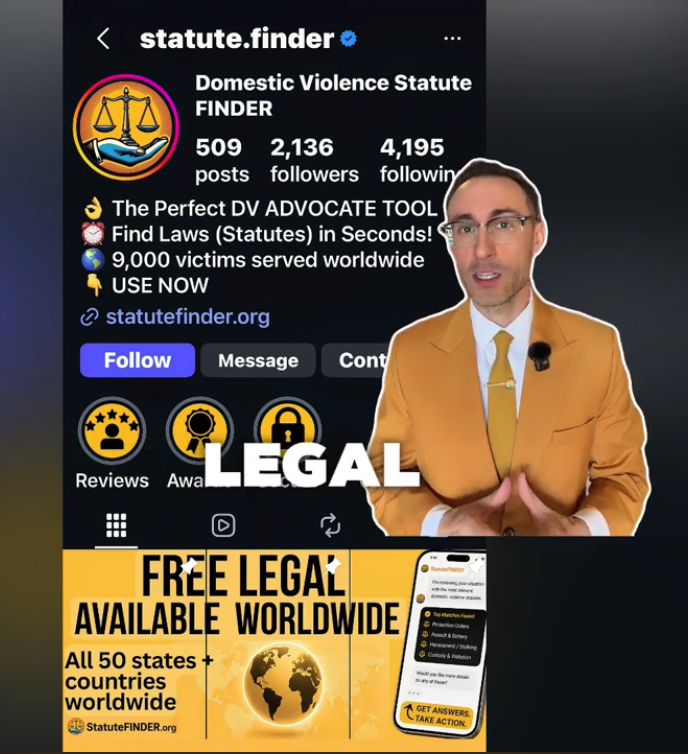
If your domestic violence agency maintains a referral list, resource directory, advocate toolkit, or survivor handout, consider adding:
When a survivor needs free legal information and help understanding their rights, send them to us.
We’re available 24/7, we’re multilingual, and our resource is free.
And to the National Domestic Violence Hotline: thank you for the work you do connecting survivors with resources.
We’re grateful that StatuteFINDER was reviewed and added to your directory of service providers, and we will continue doing our part to serve survivors who find their way to us.
Disclosure: StatuteFINDER is an independent nonprofit organization and is not partnered with, sponsored by, or endorsed by the National Domestic Violence Hotline. Inclusion in The Hotline’s directory of service providers should not be interpreted as an endorsement or partnership. StatuteFINDER provides legal information, not legal advice.