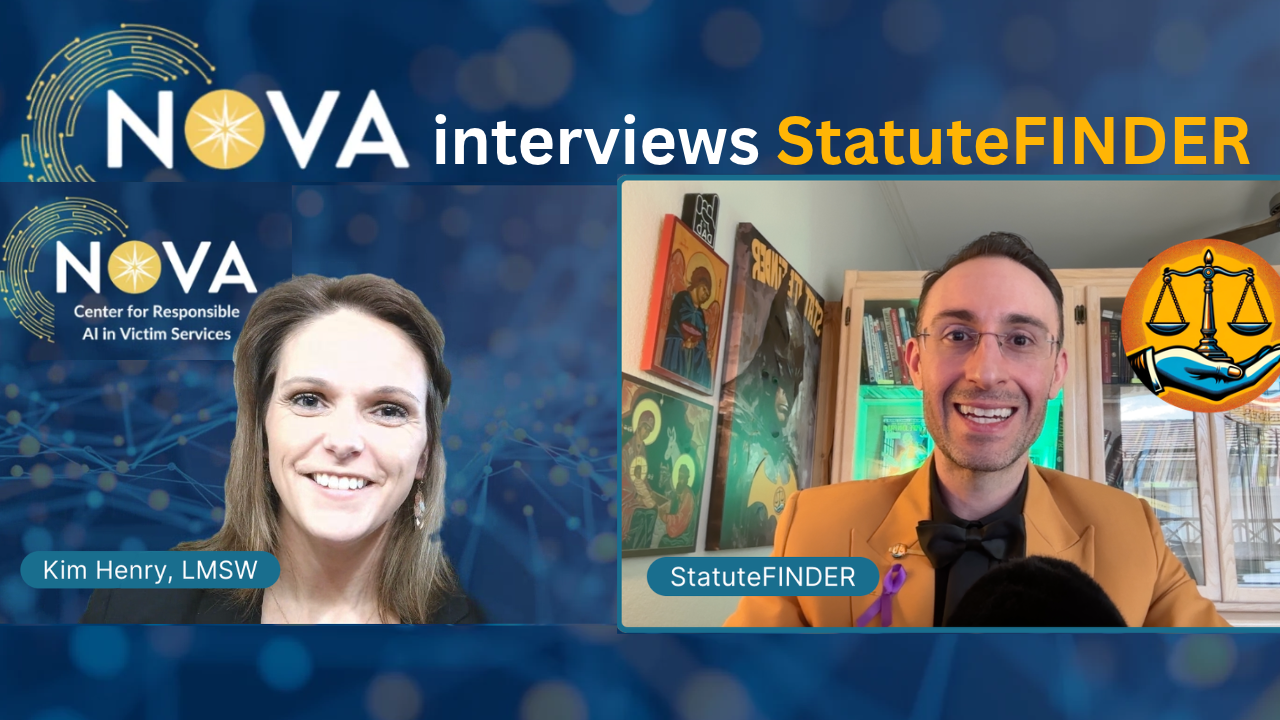
Conversation on Ethics, AI, and Advocacy
Between Kim Henry, LMSW, from the NOVA Center for Responsible AI in Victim Services, and Rafael Testai, founder of StatuteFINDER.org
QUESTION #1: The problem and purpose:
If you don't know your rights, the statutes that protect you, it's as good as not having them.
For decades, advocacy organizations fought to get laws passed that protect survivors of domestic violence. Passing those laws was only part of the mission. A survivor still has to know those laws exist, and name them when it counts.
Police, detectives, and judges speak the language of statutes. When a survivor names the statute, it's like a lightbulb goes on in the head of that officer or that judge. Suddenly you're speaking their language. You're heard. You're understood. In about 1 in 4 StatuteFINDER conversations, the survivor told us the police or the courts had not helped them. The statute is the leverage.
I know that because I lived it. Knowing my statutes is how I turned my own case around.
The law is complicated, it changes, and nobody has it memorized, not the sharpest attorney, not the judge. That is exactly what AI is good at. So I built StatuteFINDER with one mission: help survivors know their rights in 60 seconds or less, for free.
QUESTION #2: What the technology does: In plain language, what does the tool do, who is it intended to support, and how might it be used in victim services?
StatuteFINDER matches your situation to the statutes, the laws that may protect you, typically in 60 seconds or less.
You describe what happened in your own words, like you would to a friend or an advocate. She put a GPS tracker on my car. She burned my clothes. She drained the bank account. StatuteFINDER identifies the statutes for your state and cites them, with links to the law itself.
But we don't stop there. StatuteFINDER gives you free legal resources inside the conversation and helps you build a plan with concrete steps to improve your situation. You can upload documents, like a police report, and get feedback on it.
No training manual, no account, no login, no payment. Ever.
More than nine thousand survivors have already used StatuteFINDER, from all fifty states, in English, Spanish, Chinese, and Vietnamese. Six in ten conversations happen outside business hours, nights and weekends, when no office is open. Half of them involve children. We know all of that because we measure it.
QUESTION #3: Trauma-informed design and perspectives: What, if any, survivor or advocate perspectives have informed its development? How do you approach safety, survivor choice, accessibility, and trauma-informed practice?
I'm a survivor of domestic violence. When I asked for help, I was turned away because of my gender. It taught me one thing I built into StatuteFINDER from day one: nobody gets turned away. Not for gender, background, or beliefs.
Before this, I built, launched, and successfully sold a mobile application called EventKey, and I was named Hispanic entrepreneur of the year in Phoenix in 2016. But my own case gave this work its purpose. Knowing my statutes is how I defied the odds.
What has shaped StatuteFINDER since then is more than nine thousand survivors, plus the advocates, attorneys, and police officers who give us their input, plus focus groups. There's an art to that. You watch what people do, not what they say they need. Those two are often different.
And I prayed for wisdom and understanding throughout this, and I still do. God and the Bible are the center of my moral compass. That's where my ethics come from.
NOW LET’S TALK ABOUT SAFETY:
Safety starts with control. With StatuteFINDER, you share only what you're comfortable sharing. There's no login, no payment, no download. You never have to identify yourself to get full value.
Survivors have told us they felt more comfortable telling an AI what happened because they knew they were not being judged. Men in particular reported that. We're here for everyone, and everyone includes men.
We focus on the facts, the evidence, and the law. We don't tell a survivor what to do. We show them their rights, their statutes, and the avenues, and they decide. That's survivor choice without the jargon.
We also built for AI's own risks. One is sycophancy , where an AI agrees with everything you say. We put guardrails on that. And when a survivor signals self-harm or immediate danger, StatuteFINDER is designed to point them to 911, 988, or a crisis line before anything else. Those are fewer than two in a hundred conversations, and every one of them is checked afterward, after it's de-identified. More on that layer of protection in a minute.
QUESTION #4: Privacy, confidentiality, and human oversight: At a high level, what information does the tool collect, process, or retain? What safeguards and human review are important to its use?
Think of StatuteFINDER as a hotline you text instead of call. Like any good hotline, we monitor the quality of every conversation.
StatuteFINDER has no account, no login, and asks for no name. We keep de-identified conversations, with no scheduled deletion date, for one purpose: improving our service. That's the exact phrase in our privacy policy. We review our answers, find what to improve, and test the improvement.
De-identified means our anonymizer replaces identifying details with labels before any review. A name becomes the label VICTIM ONE. A phone number becomes the label PHONE. Nothing a survivor wrote appears in anything we publish. Our reports hold numbers and yes-or-no findings only. Which topics came up, whether a next step was discussed, which state. By design, the report cannot hold a sentence. Engineers call this data minimization.
Why keep conversations? Suppose six weeks from now we find a way to make an answer clearer. We need to see what was asked and how we answered. Delete it after 30 days and that lesson is gone. Engineers call this observability: knowing how the service performed instead of guessing. My background building software for hospitals and financial institutions is how I approach this.
And here is the line we don't cross. We do not sell survivor conversations. We do not share them with any organization. No exceptions. That's a core value, and it's non-negotiable.
LET’S TALK SAFEGUARDS & HUMAN REVIEW:
Every conversation is quality-checked. One hundred percent, every month, not a sample. Most industries audit a sample. A call center manager listens to a few recordings. We check every conversation against written standards: what the survivor needed, whether they were in danger, which statutes StatuteFINDER provided, and how it responded.
Who reads them? An independent monitoring system that I built, and a small internal team. No person outside StatuteFINDER reads a conversation.
This is called post-deployment monitoring, and it's what the National Institute of Standards and Technology recommends in its AI Risk Management Framework. When a monthly result doesn't meet our standards, we find the cause, correct it, and confirm the improvement.
My commitment is that survivors get legal information without exposing their private lives.
QUESTION #5: Limitations, risks, and boundaries: What are the most important limitations or potential risks? When should the technology not be used or relied upon?
AI can be wrong, and it can be wrong convincingly. That's the limitation that matters most, and it's why I don't just trust StatuteFINDER. I measure it. In AI engineering that's called evals, evaluations, and I'll come back to that.
StatuteFINDER provides legal information, not legal advice. It shows you your rights, the statutes, and the avenues. Survivors have used it as a court companion to represent themselves, and won, because it helped them speak the language judges understand. But the decisions are theirs.
Laws vary by state, so the jurisdiction has to be right. Every statute we cite comes with a link to the law itself, so you can read it, and you should. And if a link is ever broken, copy the statute code into Google and you'll land on the law in seconds.
It's not an emergency service. If someone is in danger tonight, the answer is 911 or a crisis line, and StatuteFINDER is designed to say so.
QUESTION #6: Looking ahead: What do you believe responsible AI development and use in victim services should look like, and what should the field be asking as these tools evolve?
Good intentions are not enough. The field should ask every AI builder one question: how do you know it's helping, and what's your evidence?
Here is the term I want every advocate to take away: evals. Short for evaluations. This is AI Engineering by Chip Huyen. Five hundred pages. Evals are the only topic in this book that gets two whole chapters. That tells you how important they are. Greg Brockman, the co-founder of ChatGPT, put it this way: evals are surprisingly often all you need.
An eval starts with a hard question: what does "correct" mean? Ask several experienced advocates or attorneys how they'd approach the same situation and their answers will differ. Two attorneys walk into court, both convinced they're right, and one loses. There is no single right answer. So we don't grade replies as right or wrong. We check whether the survivor got accurate statutes and a clear picture of the avenues that exist, many of which they didn't know about. And we leave every decision to them.
Then you need something that can read thousands of conversations a month. No person can. So you build what's called an AI judge. The hard part is that the judge has to be aligned with human expertise. A person with domain knowledge teaches it how to think about a conversation, not just what to look for. It takes a lot of manual work, and you retest the judge every time your standards change. That's the work most people skip.
One more thing. One hundred percent of StatuteFINDER's software was built in-house. No contractors, no outsourcing. As the founder, I know how every piece works, and I'm accountable for it.
That's what responsible AI should look like: measured, tested, and owned.
QUESTION #7: How does the tool verify current statutes and handle unclear or inaccurate outputs?
When StatuteFINDER identifies a statute, it cites it and links to it on the same official sources attorneys, judges, and police use. Those sources update independently, so the survivor reads the current law directly.
Each month our monitoring records every statute StatuteFINDER cited, in every conversation. Where statutes were provided, that's about five laws per conversation.
Unclear outputs go through the process I described: every conversation checked against written standards. The ones that can be improved, we improve. That is the reason we keep de-identified conversations. You can't improve what you deleted. And when you can improve continuously, like we have, you become safer and more useful every month.
CLOSING
Thank you for this conversation, and for the work NOVA does for survivors.
At StatuteFINDER we define success by how many people we helped and how well. More than 9,000 survivors. And in seven out of ten conversations, the survivor, in their own words, was considering, planning, or already committed to a concrete next step: filing for an order, saving evidence, calling legal aid, making a safety plan. That's evidence that StatuteFINDER doesn't just help survivors know their rights. They act on them.
We also have more than twenty video testimonials from real survivors who reached out on their own to share their experiences and outcomes. I have yet to see another AI-powered domestic violence resource document that level of firsthand survivor impact.
Some respected people in this field told me not to build this. I listened, and I built it anyway. Peter Thiel, the Silicon Valley investor who co-founded PayPal, asks what important truth very few people agree with you on. Mine is that survivors can handle their own rights, if you give them the statutes.
We make decisions on evidence, survivor feedback, measurement, lived experience, and prayer. I'm decisively and unapologetically Catholic, and I made a promise to God during the worst days of my life. StatuteFINDER is how I keep it.
We can't do this alone. Technology is half of it. People and relationships are the other half. Family advocacy centers, police departments, and domestic violence organizations have invited me to present, and advocates have driven in from every corner of the state to hear how AI works and how to use StatuteFINDER. I'm glad to keep doing that with anyone who wants to build this responsibly.
Thank you again. I hope this is the start of a lasting relationship.